
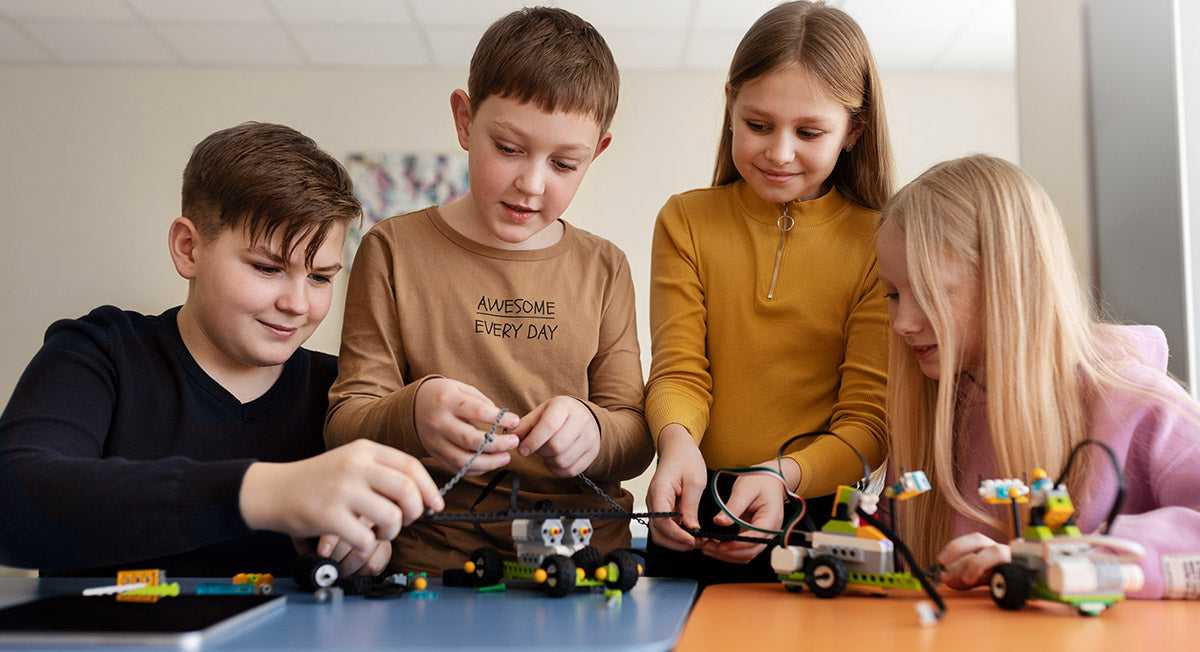
Imagine a world where children are able to build their own inventions to solve real-world problems. This is already happening with robotics in schools, where students are learning to think like scientists and engineers. Robotics is much more than just programming machines: it's a gateway to creativity, critical thinking, and teamwork . In this article, we explore how robotics is shaping the next generation of inventors, transforming classrooms into true innovation labs.
An Introduction to Robotics in Education
Robotics is revolutionizing the way we teach science, technology, engineering , and mathematics (STEM). Instead of learning abstract concepts, students now have the opportunity to see how these ideas work in practice. With platforms like Lego Mindstorms , VEX Robotics , and other educational robotics kits, children can build robots that move, solve puzzles, or even compete in challenges.
By building robots, children learn about physics, electronics , and programming in a hands-on and fun way. A simple robot that follows a line on the floor can teach them about sensors and programming logic, while a more complex robot can be a lesson in mechanics and advanced algorithms. All this in an environment that stimulates curiosity and the desire to experiment.
Critical Thinking and Creativity
Robotics is not just about technology; it's a powerful tool for developing critical thinking and creativity. When students face hands-on challenges – such as getting a robot to navigate an obstacle course or complete a specific task – they need to think of innovative solutions. Every mistake is a learning opportunity, and every success reinforces their confidence in their abilities.
Building a robot isn't the end of the journey; it's just the beginning. Students must program the robot to perform a specific task, adjusting the programming whenever something doesn't work as expected. This trial-and-error process helps them develop a resilient mindset and understand that problems have more than one solution.
Robots and the Real World
Robotics is already transforming the world we live in. From robots exploring Mars to machines assisting in delicate surgeries, the applications of robotics are vast and impressive. Bringing these real - life examples into the classroom allows children to see how what they are learning today can impact the world of tomorrow.
Encouraging students to imagine how they can apply robotics in real life is a powerful way to inspire them. Could they invent a robot that would help clean the oceans? Or create machines that improve the efficiency of agriculture? The possibilities are endless, and robotics gives them the opportunity to think big and dream of inventions that could change the world.
Robotics Challenges and Competitions
Competing in robotics challenges is an exciting experience that involves teamwork , innovation, and a lot of passion. The competitions are global events where children build and program robots to complete complex missions. These encourage students to apply their knowledge creatively and collaborate with their peers to achieve a common goal.
Furthermore, competitions teach valuable lessons about persistence and teamwork .
Winning or losing isn't the most important thing; what matters is the learning process, the development of skills, and the opportunity to challenge oneself to solve increasingly difficult problems.
Future Inventors: The Robots of Tomorrow
One of the most exciting aspects of robotics is the potential it offers for creating something new. Imagine a student creating a robot to help elderly people with their daily tasks, or another developing a machine to plant trees in deforested areas. Robotics teaches children to dream and think of innovative solutions to the challenges of the future.
By exploring robotics, we are preparing children and young people for a world in which technology will play an increasingly important role. In addition to acquiring ... By developing potential skills for future careers such as engineering, programming, and product design , children and young people are learning that they have the power to create, innovate, and transform the world around them.
Conclusion
Robotics in schools isn't just about teaching technology ; it's about inspiring the next generation of inventors. Through hands-on activities, competitions, and innovative projects, children are discovering the power of creation and developing skills that will be fundamental to their future. As they build, program, and solve problems, they learn that innovation is within their reach and that the future can be built with their own hands.
With robotics, today's children and young people are shaping tomorrow.