
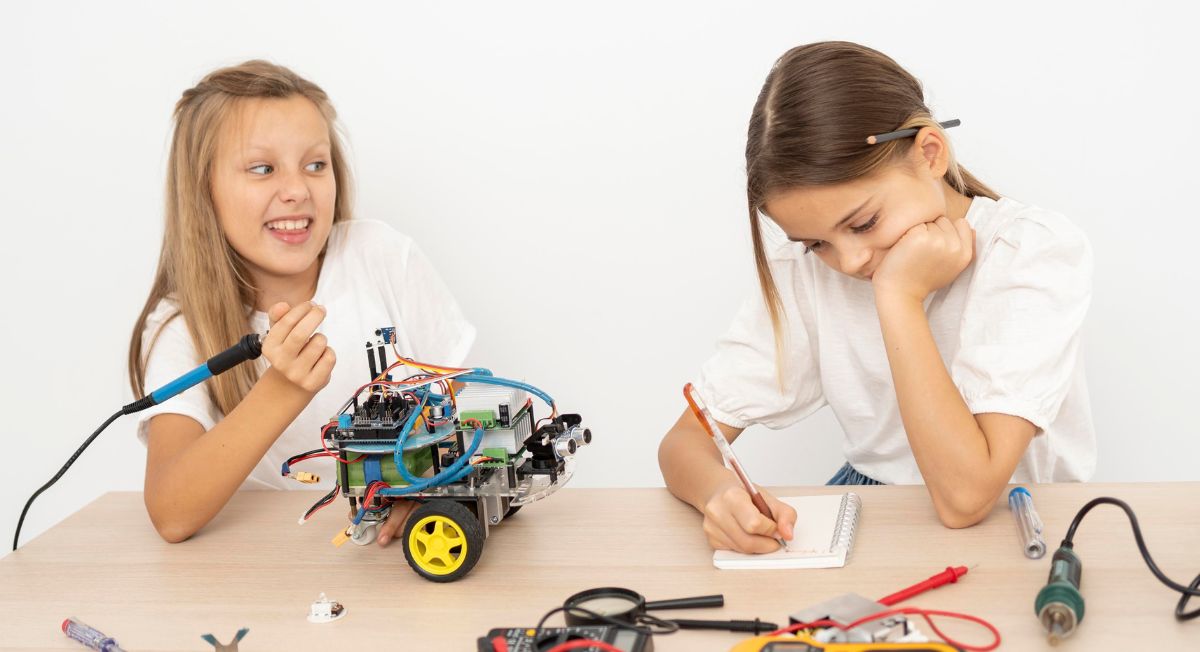
Summer vacation is an excellent opportunity for children to engage in educational and fun activities, such as robotics. With advances in technology and the availability of affordable robotics kits, it's possible to carry out incredible projects at home. In this article, we suggest some robotics activities that can be done with basic materials and electronic components, providing learning and fun moments for the whole family.
1. Toothbrush Robot
Materials Needed:
-An old toothbrush;
-A small vibrating motor (like those found in old cell phones);
-A AAA battery;
-Double-sided adhesive tape;
-Connecting wires.
Instructions:
Cut the end off the toothbrush handle, leaving only the part with the bristles.
Use the double-sided tape to attach the vibrating motor to the top of the brush.
Connect the wires from the vibratory motor to the battery, ensuring that it is securely fastened.
Place the toothbrush on a flat surface and watch it "walk" when the motor is turned on.
This simple project teaches the basic principles of electrical circuits and vibration, while also providing lots of fun.
2. Drawing Robot
Materials Needed:
-A plastic cup;
Three or four markers of different colors;
-A small motor (like a toy motor);
-One AA battery;
-Adhesive tape;
-Ice cream sticks;
-Connecting wires.
Instructions:
-Attach the markers around the cup with the pointed end down, using the tape.
-Secure the motor to the top of the cup using adhesive tape.
Connect the motor wires to the battery and secure them with tape.
Place the cup on a large sheet of paper and turn on the motor. The robot will begin to move and draw patterns on the paper.
This project not only teaches about circuits, but also allows children to explore their artistic creativity.
3. Line Follower Robot
Materials Needed:
-A basic robotics kit;
Two direct current motors;
Infrared (IR) sensors;
-Wheel and axle;
-Black electrical tape;
Batteries;
-Connecting wires.
Instructions:
Assemble the robot's base with wheels and axles.
Connect the DC motors to the base.
-Attach the IR sensors to the front of the robot, pointing them towards the ground.
Use a robotics kit to program the motors to follow a black line drawn on the floor with electrical tape.
Place the robot on a path marked with a black line and observe it following the trajectory.
This project is more advanced and introduces concepts of programming and sensors, making it ideal for older children or those with some prior knowledge of electronics and robotics.
4. Cleaning Robot
Materials Needed:
-A shoebox;
-A direct current motor;
-One AA battery;
Microfiber cloth;
-Connecting wires;
Adhesive tape.
Instructions:
-Make small holes in the bottom of the shoebox for the motor wires to pass through.
-Secure the motor to the inside of the box.
-Attach the microfiber cloth to the bottom of the shoebox.
Connect the motor to the battery using the connecting wires.
Place the robot on a flat surface and turn it on. The motor will cause the box to move and the microfiber cloth to clean the floor.
This project is simple and functional, teaching basic concepts of mechanics and automated cleaning.
Conclusion:
Doing robotics projects at home during the holidays is a great way to keep children engaged, learning, and having fun. With accessible materials and a little creativity, it's possible to create amazing robots that not only teach basic principles of electronics and programming, but also stimulate creativity and critical thinking.
Try these activities and see the magic of robotics transform your summer vacation into an unforgettable educational adventure.
Check out all our articles here .
Follow all our news here .