
The concept of time is an important skill for children's development in early childhood education, as it allows them to understand the sequence of events, organize their routines, and comprehend the world around them.
Initially, the concept of time can be difficult for children to grasp.
Furthermore, it is a somewhat abstract subject to teach, which leads to added difficulty for parents and teachers.
In this article, we will show some tips and suggestions on how you can do this with your students or your children.
At what age does the concept of time emerge?
The concept of time is a skill that develops gradually throughout childhood, but children generally begin to have a basic understanding of time around the age of 3.
At this age, young children can understand simple concepts such as "tomorrow," "today," "yesterday," and "now." They are also able to begin to understand the duration of simple events, such as a song or a story.
As children grow, their understanding of time deepens, and they begin to grasp more complex concepts such as the passage of time, the seasons, the days of the week, months, and years. By around age 6, many children are already able to tell the time on a clock with hands.
However, it's important to remember that every child is unique and can develop this skill at their own pace.
It is then up to parents and educators to find, invent, or reinvent activities that stimulate them.
How can you teach the concept of time?
The best way to teach a child the concept of time is to stimulate them daily with perceptual exercises and activities.
However, it is essential to use a playful approach adapted to the age and level of understanding of each child.
There are several ways to teach children about time in early childhood education. Some suggestions include:
- -Calendars: Using a daily, weekly, or monthly calendar can help children understand the passage of time, days of the week, dates, and important events.
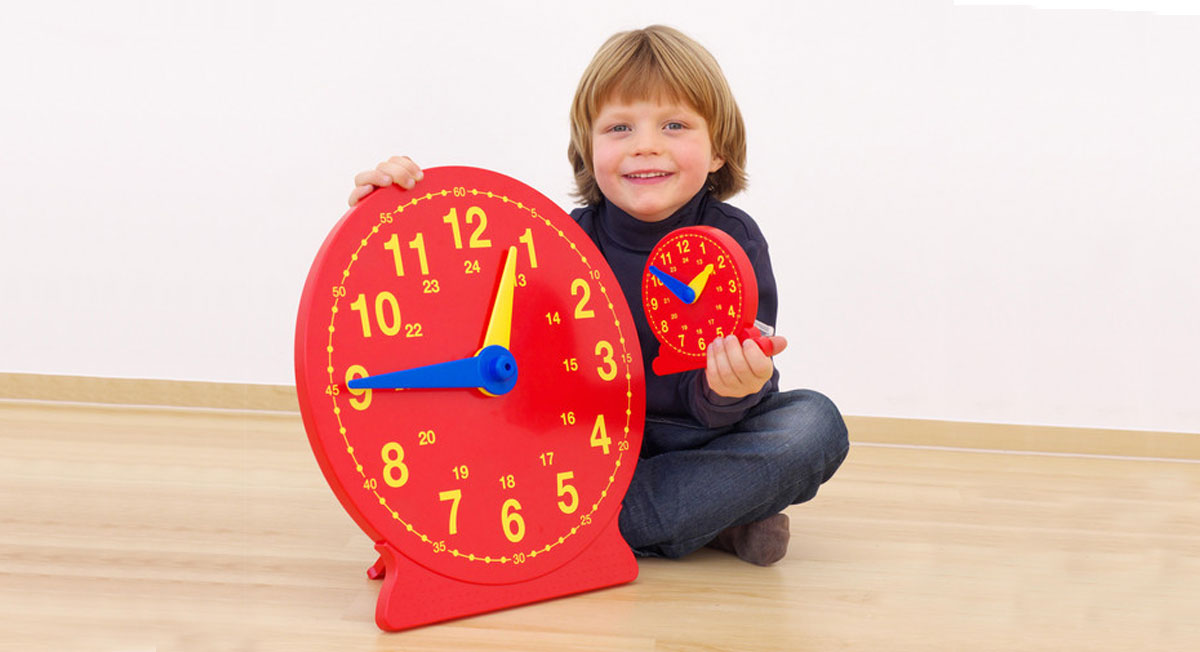
- Clocks: Introducing clocks with hands to children and teaching them how to tell time helps them understand how time is measured.
- -Routines: Creating daily routines with set times for activities such as snacks, playtime, reading, and others can help children develop a sense of time and organization.
- -Stories: telling stories that have a clear temporal sequence, with a beginning, middle, and end, can help children understand the passage of time and realize how events are related.
- -Games: games that involve the passage of time, such as board games that simulate a day in the life of a family.
- - Practical activities: involve children in practical activities with a defined duration, such as planting a seed and monitoring its growth.
- Ask the children to recount the activities they did each day after school.
How can you teach the days of the week in early childhood education?
Through songs and routine activities, children are able to better understand the days of the week and develop a sense of time.
Here are some suggestions for teaching children both at school and at home:
At school:
- Before the start of class, the teacher should say the name of the week;
- -Use the calendar daily;
- -Create worksheets that allow students to order the days of the week and identify them correctly;
- -Use children's songs that teach the days of the week in a simple and fun way.
At home:
- -Use simple phrases like: "After dinner, you will brush your teeth" and "Before we have dinner, you have to do your homework";
- - Engage in fun family activities such as playing games or reading books;
- -Have daily conversations with a simple timeline, such as asking how their day at school was; talking about events that occurred when they were a baby.
The importance of the concept of time.
Having a correct sense of time is essential for children, as it allows them to understand and deal with the passage of time more effectively and efficiently. These are some of the benefits of developing this skill well:
- -Greater efficiency in carrying out tasks;
- Responsibility for one's behavior and material possessions;
- -Planning and organization;
- Prioritizing the tasks to be completed;
- -Temporal awareness;
- Better communication.
Conclusion
In this article, we present solutions for working on the concept of time with children and demonstrate how this skill can be so important for their lives.
As mentioned earlier, the concept of time is primarily developed through daily activities, whether at school or at home.
Therefore, it is important for parents and educators to encourage this skill in children's daily lives.
Did you like the tips we presented? Were you already familiar with or practicing any of these suggestions with your children?
Tell us all about it in the comments.
Follow all our news here .