
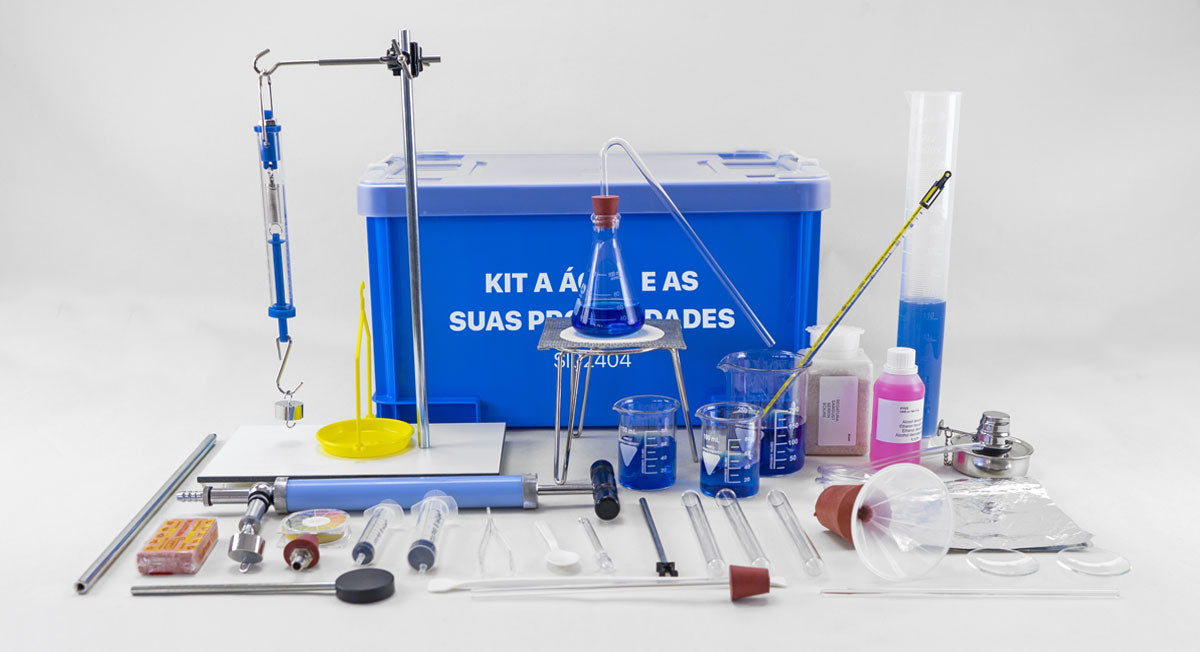
The study of science and technology can sometimes become complex and difficult for students. Therefore, it is necessary to innovate teaching methods to make them simpler, leading to greater effectiveness throughout students' academic journey.
In this article, we will introduce you to educational kits, explain what they are for, and why teachers should use them in their classes.
What are educational kits and what are their objectives?
Educational kits are sets of materials and teaching resources that are designed to aid in learning specific topics.
Typically, the kits include a variety of materials, such as books, videos, experiments, games, and other interactive activities that help students learn in a hands-on and engaging way.
Furthermore, educational kits function as tools that often increase students' interest in Science and Technology.
The goal of educational kits is to make learning subjects simpler and more understandable for students.
These kits make education easier for teachers, as they can be used as a teaching strategy to improve student performance.
Thus, classes become more dynamic, reducing the chance of students getting bored or finding the subject difficult.
Examples of Educational Kits
VEX IQ Education Kit
The VEX IQ Education Kit is an educational set designed to introduce knowledge in the area of robotics and programming. This kit includes various robotics components, such as motors and other easy-to-operate electronic features, which will allow children to create their own programmable constructions in a matter of minutes.
Kit - Air and its properties
The Kit - Air and its Properties is an educational set composed of essential materials for teaching science. Through it, students can learn about the composition of air, its interaction with the environment, and how they can interact with it safely and efficiently.
Sensor Kit I
The Sensor Kit I features different types of sensors for multiple experiments. This kit contains sensors to measure light, force, sound, pressure, heart rate, weight, temperature, distance, and movement. With this set, it is possible, for example, to measure the decibels of noise in a room using the sound sensor.
Kit - Renewable Energies
The Renewable Energy Kit is a complete and essential resource for studying science in a school setting. Through this kit, it's possible to understand different topics related to renewable energy, such as the concept of energy in physics, kinetic energy, gravitational potential energy, and elastic potential energy.
Advantages of using educational kits in Science and Technology education.
- Hands-on learning: Educational kits offer students an opportunity to learn by doing, experimenting with and manipulating real objects and equipment instead of just learning through theoretical explanations.
- Stimulating creativity and innovation: By using educational kits, students are encouraged to think outside the box, create and innovate, which helps develop their creativity and problem-solving skills.
- Personalized learning: Educational kits can be customized to meet the specific needs and interests of students, making the learning process more engaging and relevant to them.
- It helps them engage with technology : By building objects that they can use in their daily lives.
- Preparing for the real world: Educational kits often feature activities that simulate real-world situations, helping students understand how science and technology are applied in their daily lives.
Conclusion
In this article, we present educational kits as an alternative to traditional teaching, in order to motivate students to learn Science and Technology.
These sets of tools play a fundamental role in improving students' understanding of subjects that may be considered more complex.
Do you have any more questions about educational kits?
Have you used them in a school setting? What were the results?
Tell us in the comments.
Follow all our news here .