
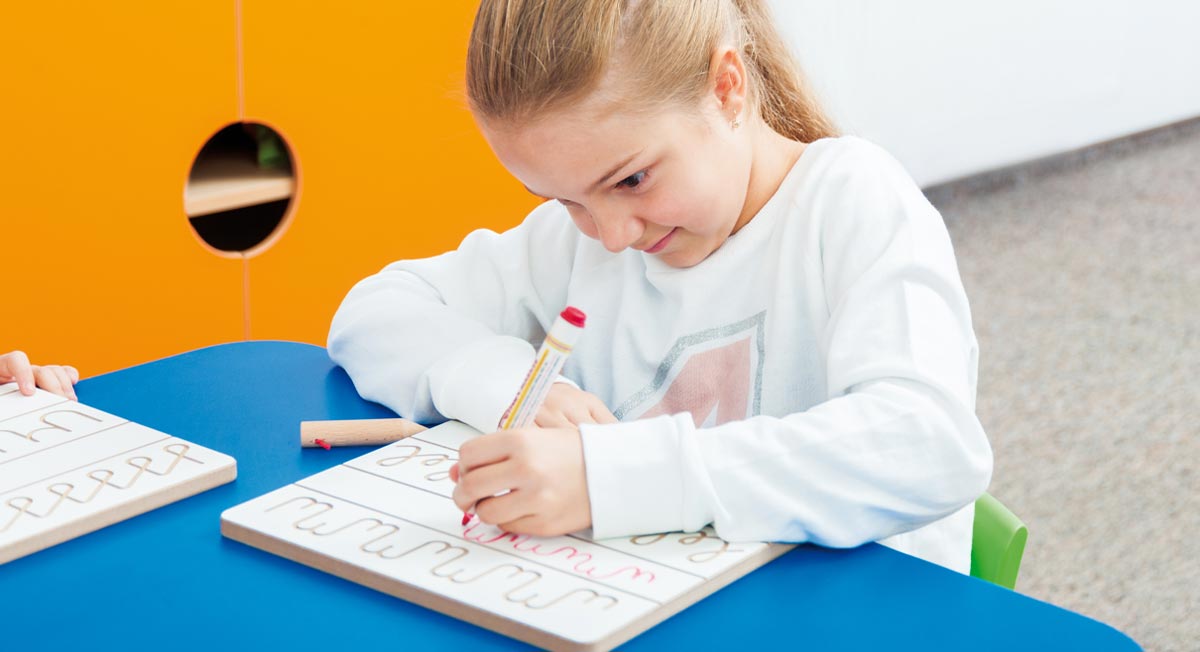
Writing is one of the most important and fundamental skills that children acquire during their educational process. However, the development of writing goes beyond the mere act of forming letters and words. It involves a series of motor, cognitive, and perceptual skills, with fine motor skills being one of the essential aspects in this process.
The role of fine motor skills in the development of writing.
Fine motor skills refer to the control and coordination of the small muscles in the hands and fingers. This ability is fundamental for performing precise activities, such as holding a pencil, drawing lines, sketching shapes, and ultimately, writing. The development of fine motor skills is an important milestone in children's journey towards writing, as it allows them to have control and precision in the movements necessary for writing.
The development of fine motor skills from the earliest years.
From their earliest years, children begin to develop fine motor skills through simple activities such as manipulating objects and painting. These sensory experiences help strengthen the muscles in their hands and fingers, improving the control and dexterity needed to write legibly and coherently.

Improving fine motor skills during growth
As children grow, their fine motor skills continue to be refined through a variety of specific activities. Using pencils, pens, crayons, and paintbrushes allows them to practice different writing and drawing techniques, perfecting their movements and stimulating their hand-eye coordination.
The relationship between fine motor skills, cognitive and perceptual skills.
It is important to highlight that the development of fine motor skills does not occur gradually, but in conjunction with other cognitive and perceptual abilities. As the child manipulates objects and performs writing activities, they are constantly stimulating areas of the brain responsible for planning, attention, visual memory, and visuomotor coordination. These cognitive skills are crucial for the development of writing and, in turn, are enhanced as fine motor skills develop.

Creative expression and self-confidence
Furthermore, fine motor skills also play a significant role in creative expression and the development of self-confidence. By having control over their own movements and being able to create shapes and designs, children feel empowered and encouraged to explore their creativity through writing. This connection between fine motor skills, creative expression, and self-confidence contributes to healthy overall development.
The role of educators and teachers in stimulating fine motor skills.
Educators and teachers play a fundamental role in stimulating and improving children's fine motor skills. By promoting specific activities, such as cutting, gluing, and manipulating small objects, educators and teachers can help strengthen the muscles of the hands and fingers. In this way, they are preparing children for writing. It is also important to encourage the use of appropriate and ergonomic materials, such as pencils with patterned thickness and texture, to ensure comfort and correct posture during writing.
In short, the relationship between fine motor skills and the development of writing is undeniable. The ability to control hand and finger movements is essential for children to acquire effective and fluent writing skills. Therefore, it is crucial to provide opportunities and activities that stimulate the development of fine motor skills from the earliest years of life.
Check out all our articles here .
Follow all our news here .