
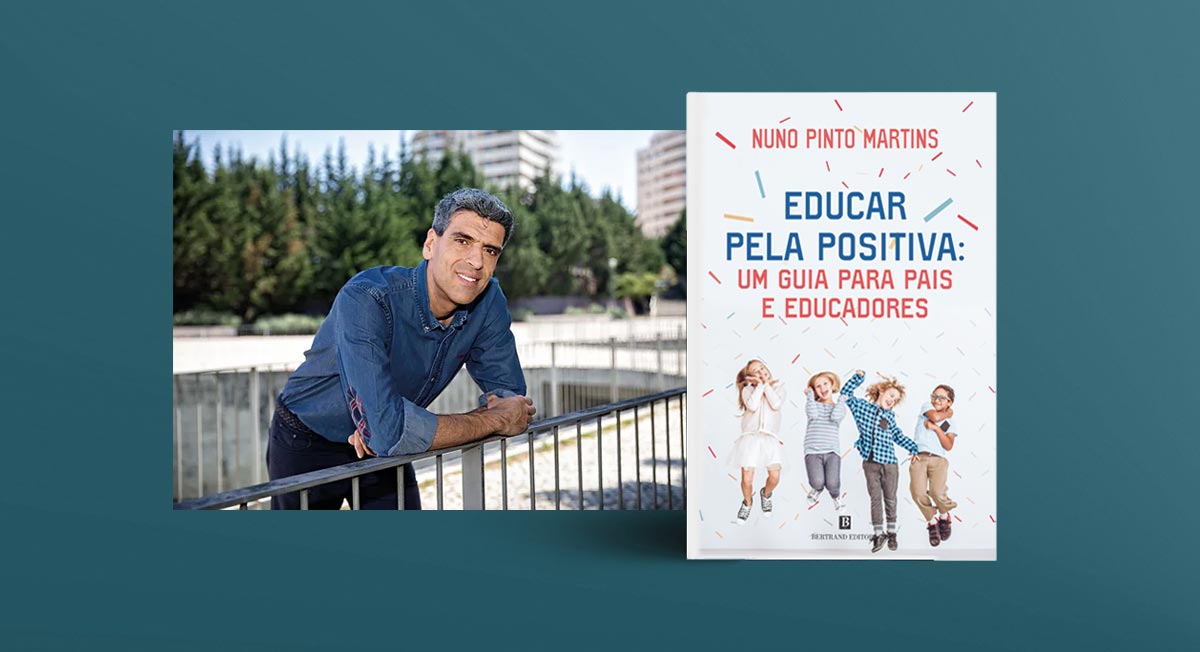
Nuno Martins is an education mentor and coach who wrote his book "Educating Positively" following educational training sessions throughout the country.
The author developed a methodology based on a more positive approach to education, significantly transforming his relationship with his children and the home environment.
The World of Education spoke with Nuno Martins, who presented his book in more detail and helped us understand his teaching methodology in practice. Throughout the interview, questions related to children's education will be asked, presenting real-life problems and situations that can help resolve challenging situations for parents, educators, and teachers.
1. What were the main motivations and inspirations that led Nuno to write this book?
“The book 'Educating Positively' emerged naturally, following the training sessions I conducted throughout the country. The idea was to share with parents and educators, in a more systematic way, many of the strategies and practical 'tools' of Positive Discipline, in a simple and accessible manner. A kind of reference guide, to use whenever necessary.”
2. In his book, Nuno discusses the importance of positive education, applying a more positivist approach to education. What are the pillars you consider essential for positive education?
“First, it’s important to reflect on how we are educating and the respective results. Nowadays, we tend to oscillate between two extreme educational models: authoritarianism – where we often repeat the patterns of what was done to us in childhood – and permissiveness, a result of the frenetic pace of life, where exhaustion often leads us to give in and turn a blind eye to certain behaviors and attitudes. Only by reflecting on this will we become aware of where we are, so that we can more consciously begin the process of change. This is not easy, because it requires us to leave our comfort zone, and we are not always able to or available to do so.”

3. As a mentor/coach, have you seen significant changes in the application of these Positive Education methodologies?
"Absolutely! The feedback from other parents and educators has been incredible, sharing with me the positive impact that Positive Discipline strategies and 'tools' have had on their relationships with their children/students, building relationships based on mutual respect, cooperation, and encouragement."
4. Since you started applying a new approach to parenting, have you felt that it has helped you build a healthier and closer relationship with your children?
“Yes, the difference is very significant. There is a clear before and after Positive Discipline in my relationship with my two children, now 9 and 13 years old. I started applying this educational method when they were 2 and 6 years old, and since then our relationship has changed a lot, for the better. We function as a team, we respect each other and we grow together every day. This doesn't invalidate my role as an educator; on the contrary, it's very strong, but I don't need to yell, hit, or punish to be heard and respected.”
5. Sometimes, parents may face challenges and difficulties in implementing positive parenting. What are some of the main barriers parents may encounter, and how can they be overcome?
“There are 5 common mistakes that parents and educators make when they start positive parenting. The first is thinking they can always be patient and easily apply the strategies and “tools.” They would have to be machines to achieve that perfection… We are human, we will always have more difficult moments, more complicated days, we will fail and make mistakes… But mistakes are fantastic opportunities to learn! The second mistake is focusing only on the “positive” and forgetting the importance of rules, limits, and routines. If this happens, we will be being permissive and not positive parenting. It will be linear, it will have advances and setbacks. Because children will tend to test new methods, because they find them strange.”
6. Dealing with tantrums is always a challenge for any educator. Considering your experience, what would be the most effective strategies for dealing with these behaviors?
“Tantrums are primarily a reflection of the immaturity of the child's brain, which is still developing. As such, the child is not yet able to self-control, manage their impulses, handle their emotions, or verbalize their thoughts and feelings effectively. If even we adults, with our mature brains, don't always manage this, what about children? We often demand that they be mini-adults, and this usually yields negative results, potentially devastating to their self-esteem. On the other hand, a tantrum is a way of seeking attention and may have an associated message – a need to be met, for example. It's necessary to be attentive and know the child well. One of the most effective strategies for dealing with tantrums at an early age is to change the focus, redirecting the child by removing them from the tantrum location and trying to calm them down elsewhere with a game, a silly act, etc., before correcting the behavior, without guilt or judgment.”

7. With technological advancements and the "standardization" of electronic device use from a very young age, children are exposed to screens for many hours. Do you consider this a way for parents to escape and have quieter moments at home?
“It’s easy to blame parents, who often have complicated lives and little time to rest. I believe that most parents do their best with the ‘tools’ they have. It’s true that prolonged screen time can have a harmful effect, but technology shouldn’t be seen as a bogeyman because it also brings positive things. It’s legitimate for parents to occasionally give their child a tablet or mobile phone to have those quieter moments at home, the problem is when they do it systematically… In that case, it also affects the relationship; children tend to shut themselves off in the virtual world, and in the medium to long term, this can have very negative consequences on various levels.”
8. Do you feel we are heading towards a future where children may become more dependent on electronic devices, making education even more difficult?
“Technology is here to stay and is becoming increasingly advanced. There’s no escaping it. What seems necessary to me is a greater balance, investing in quality family time, outside the home and without electronic devices. Nothing replaces these moments, which create memories that last forever.”
9. In your opinion, do new technologies and social networks currently harm the way children are educated?
“Social media is something that worries me, especially as a father, because of the difficulty in supervising what is shared. Children and teenagers don't always have the ability to filter what might be beneficial or harmful to them; they need adult guidance. On social media, they are more vulnerable to harmful content and malicious people, so it is necessary for parents to be attentive and present in order to prevent these issues.”

10. In a school setting, children sometimes clash with one another. In this sense, educators/teachers may find it difficult to keep a group of students united. In your opinion, how can Positive Education help develop unity and empathy skills?
“It’s natural for children to sometimes clash with each other; it’s a way of socializing, and they are testing limits, understanding how far they can go, and being allowed to go. These conflicts are learning opportunities. It is up to the adult to regulate these relationships, which are not always easy. Positive Discipline helps us to put children on the same page, validating the emotions of each participant without taking sides, and then helping them find a solution together. 'How can you solve the problem?' is an example of a phrase that fosters autonomy in conflict resolution, as well as unity and empathy, involving everyone in the process.”
With this interview, we were able to learn more about positive discipline and we hope to help all parents, educators, and teachers resolve some of the more challenging situations with children. The methodology applied by the author of the book "Educating Through Positive Discipline" has been a true "manual" on how to educate in a friendly and healthy way.
The World of Education thanks the author Nuno Pinto Martins for his kindness and availability for this interview, who, like us, demonstrates an enormous passion for education.
The book "Educating Positively: A Guide for Parents and Educators" is available in bookstores. Seize the opportunity to learn how to educate positively.