
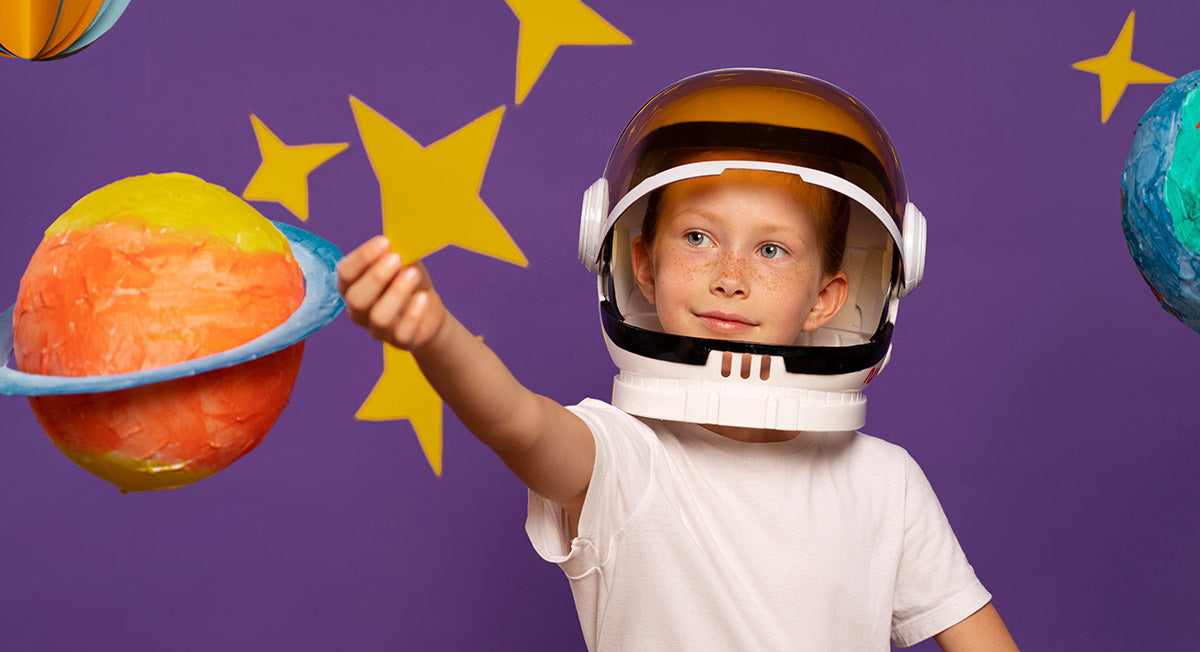
Space is a fascinating place full of mysteries, and one of the most intriguing questions many people ask is: what makes the planets rotate? The secret lies in the force of gravity and the way our solar system is organized. In this article, we will explore these ideas and better understand how planets remain in orbit, as well as suggest fun activities for creating models of the solar system!
Gravity: The Invisible Power
Gravity is a force that attracts objects to each other. The greater the mass of an object, the stronger its gravitational pull. For example, the Sun, which is much larger than any planet, exerts a very strong gravitational force. It is this force that keeps planets, like Earth, in orbit around the Sun.
When a planet rotates, it is in motion while simultaneously being pulled toward the Sun by gravity. This creates a perfect balance: the force of gravity tries to pull the planet toward the Sun, while the planet's speed causes it to move away. This combination causes planets to follow an elliptical (oval) trajectory instead of falling directly into the Sun.
The Solar System: A Cosmic Dance
Our solar system is like a large family of planets revolving around the Sun. Each planet has its own orbit, and depending on its distance from the Sun, the time it takes to complete a revolution varies. For example, Earth takes about 365 days to orbit the Sun once, while Neptune takes almost 165 years!
Besides gravity, other factors also influence the movement of planets, such as rotation (spinning around their own axis) and the orientation of their axes. A planet's rotation is what causes day and night; for example, Earth takes 24 hours to complete one rotation.
Activities: How to create a model of the Solar System
To help children visualize and understand how planets revolve around the Sun, here are some fun activities that can be done in the classroom or at home:
Activity 1: Creating a model of the Solar System
Materials:
How to do it:
Activity 2: The Gravity Experiment
Materials :
How to do it:
Conclusion: The Wonder of Space
Exploring space and understanding what makes planets rotate is an exciting adventure! Gravity is the magical force that keeps everything in motion, and our solar system is an incredible example of how science and nature are interconnected.
The proposed activities not only help to better understand these concepts, but also make learning more fun and practical . With a little imagination , children can be scientists exploring the cosmos, creating their own models and discovering the beauty of the universe!