
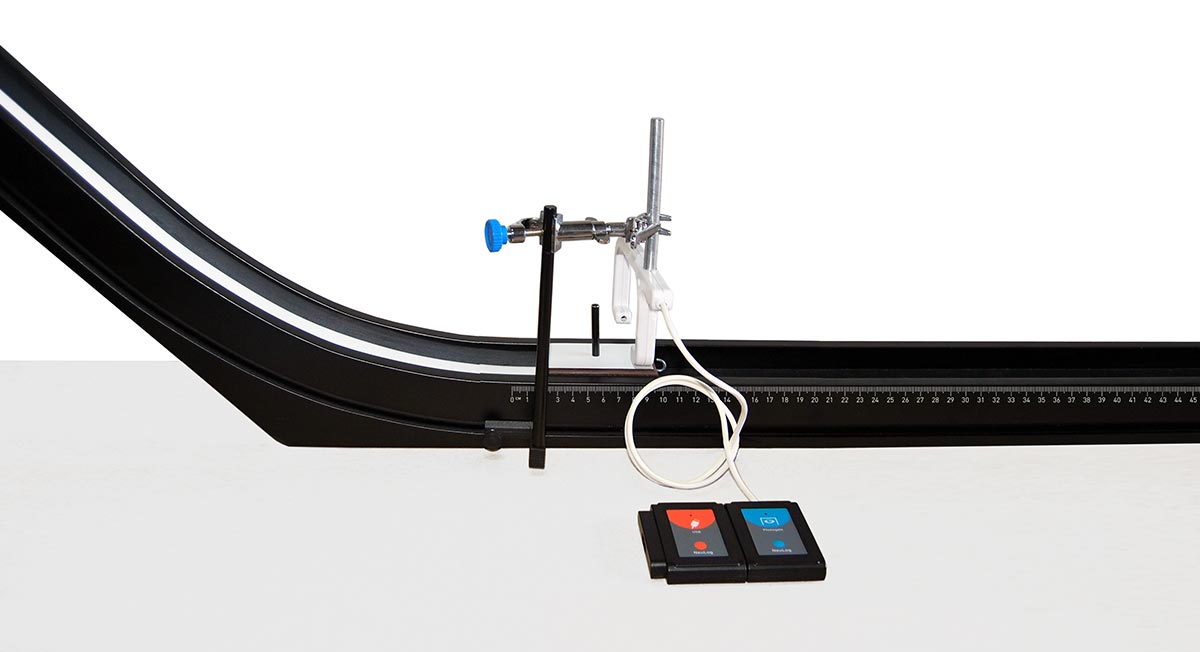
The inclined chute is a simple yet fascinating tool that allows the exploration of several fundamental principles of physics. Therefore, this practical study aims to analyze the forces involved, the laws of motion, and other physical concepts that can be observed in the interaction between an object and an inclined surface.
-
Laws of Motion:
The motion of an object sliding down an inclined track is intrinsically linked to Newton's laws of motion. Newton's First Law, also known as the law of inertia, states that an object at rest will remain at rest, and an object in motion will continue in motion at a constant speed unless acted upon by an external force. Applying this law to the inclined track, we can observe how the inclination influences the object's behavior.
Newton's Second Law, which states that the force applied to an object is equal to its mass multiplied by its acceleration, also plays a crucial role. Thus, as the object slides down the inclined track, the gravitational force acts on it, propelling it downwards. This phenomenon allows us to calculate the object's acceleration and understand how the incline affects that acceleration.
-
Forces Involved:
In addition to gravitational force, other forces come into play during movement along an inclined track. The normal force, perpendicular to the track surface, counterbalances the vertical component of the gravitational force. Thus, it results in a net force that influences the object's trajectory along the track. Understanding these forces is essential for a complete analysis of the dynamics involved.
-
Potential and Kinetic Energy:
By exploring the inclined chute, we can also observe the conversion of potential energy into kinetic energy. When an object is lifted relative to the base of the chute, it gains potential energy due to gravity. Thus, as it descends the inclined chute, this potential energy is converted into kinetic energy, directly relating to the object's speed. This phenomenon highlights the interconnection between energy and motion.
All these concepts and experiments are easily performed and understood using the inclined trough. Furthermore, in order to analyze forces, movements, and energies, it is ideal to combine this feature with Neulog motion sensors .
Conclusion:
In short, the practical study of physics through the inclined trough offers a valuable opportunity to apply and understand the fundamental principles of Newtonian physics. From the laws of motion to the forces involved and the conversion of energy, every aspect of this experiment contributes to a deeper understanding of the physical world around us. By incorporating the inclined trough into hands-on activities, students and physics enthusiasts can enrich their theoretical understanding through tangible and visually impactful experiences.