
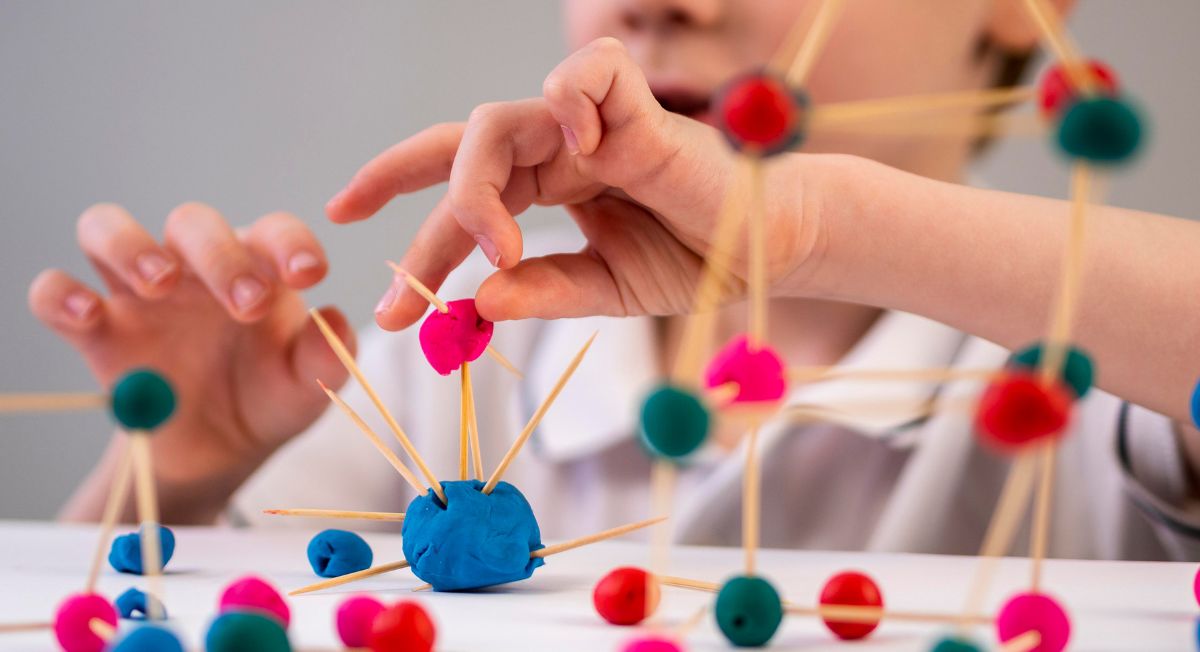
An extremely important educational tool.
The teaching and learning process is sometimes a complex and challenging path. Each student has a unique learning style and requires different approaches to absorb and understand the content.
Thus, manipulative resources emerge as an extremely important pedagogical tool, becoming a support capable of facilitating the assimilation of concepts and promoting more effective and meaningful learning.
What are manipulative resources?
Manipulative resources are educational tools to assist students and teachers in the teaching and learning process. In this way, these resources allow students to experiment, explore, and interact with content and concepts in a more concrete way.
A practical and sensory approach
They offer a hands-on, sensory approach, allowing students to visualize and manipulate objects, establishing a direct connection between abstract ideas and tangible reality. In this way, by stimulating the senses of touch, sight, and movement, manipulative resources activate multiple areas of the brain, which facilitates the understanding and retention of knowledge.
What are the benefits of manipulative resources?
Manipulative resources play a fundamental role in the educational process, providing a more dynamic, engaging, and effective approach. Here are some of their benefits for students:
-
It promotes critical thinking and logical reasoning.
By using materials such as building blocks, cubes, abacuses, puzzles, or games, students are challenged to solve problems, identify patterns, and establish relationships between elements. This direct interaction with the materials helps develop fundamental cognitive skills, such as the ability to analyze, synthesize, deduce, and generalize information.
-
They promote active and participatory learning.
Manipulative resources encourage students to engage more intensely with the content, making them the protagonists of their own learning process. In this way, by manipulating the materials, they construct knowledge more autonomously, experimenting with hypotheses, testing solutions, and developing concepts. This collaborative and practical approach contributes to greater motivation, interest, and student engagement in the learning process.
-
They encourage problem-solving in a contextualized way .
Through the manipulation of concrete objects, students are able to visualize real-life situations and apply knowledge in a meaningful way. This makes learning more relevant and allows for the transfer of acquired knowledge to everyday situations.
Diversity of manipulative resources
There are manipulative resources suitable for different age groups, areas of knowledge, and specific needs. In fact, these resources can be adapted and used according to the pedagogical objectives and specific content of each subject.
Conclusion
In short, manipulative resources are especially effective for students who learn best through hands-on and sensory experiences. They offer an alternative to traditional teaching approaches, providing a more dynamic and participatory environment where students can explore, discover, and build knowledge in a more active and meaningful way.
Consult here all of our items.
Follow all our news here .