
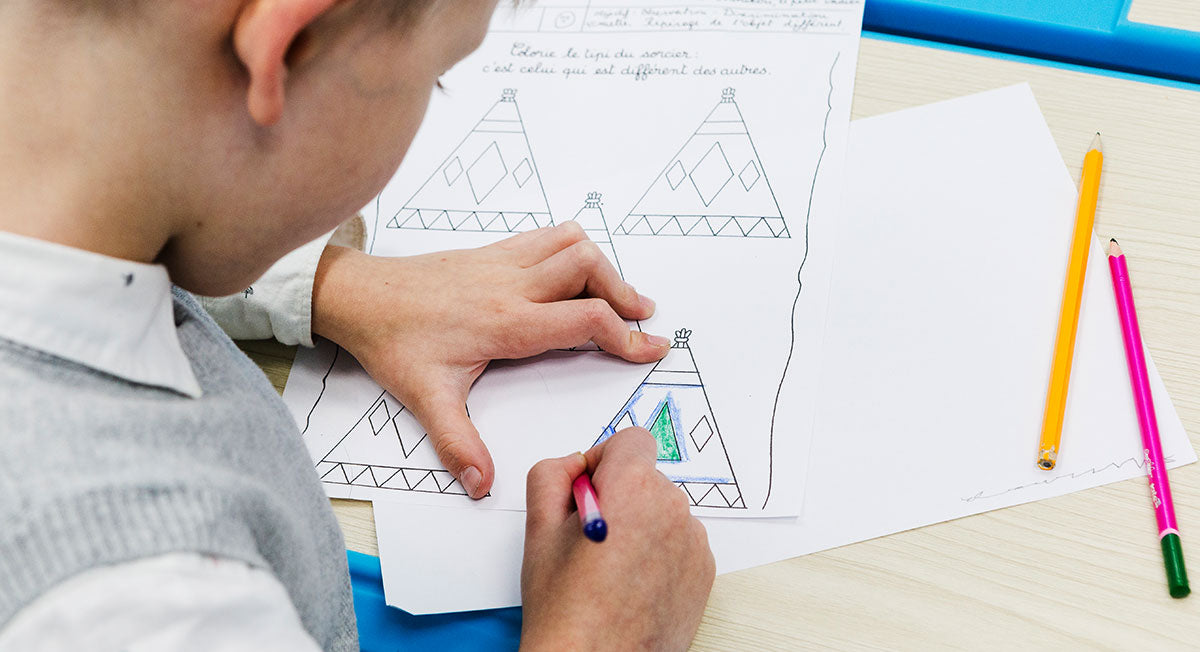
Graphomotor skills are a term that refers to the motor abilities necessary to perform graphic movements, such as writing, drawing, and tracing lines. It is a fundamental aspect of child development, as it is directly related to the acquisition of writing skills.
In this article, we will explore the importance of graphomotor skills and how their proper development contributes to the cognitive and motor growth of children.
Development of children's graphomotor skills.
Graphomotor skills begin to develop from the earliest years of life. Initially, children start making broad, unstructured movements, like random scribbles, which are their first strokes. As they grow and develop, these strokes become more controlled and precise, allowing them to create more recognizable shapes.
Importance of Motor Coordination
Motor coordination plays a crucial role in graphomotor skills and the development of writing. It involves the ability to control and coordinate the fine muscle movements of the hands, fingers, and wrists.
Furthermore, as children improve their motor coordination, it becomes easier for them to hold a pencil or pen correctly and produce letters and numbers clearly.
Benefits of Developing Graphomotor Skills
Acquisition of Writing Skills: Properly developed graphomotor skills prepare children for the acquisition of writing. When they have well-developed fine motor skills, it becomes easier to learn to form letters, write words, and construct coherent sentences.
Creative Expression: The ability to draw and write allows children to express their creativity. They can convey thoughts, ideas, and emotions through images and words, which contributes to the development of imagination and language.
Cognitive Development: Graphomotor skills are also related to cognitive development. Through movement and fine motor coordination, children exercise their brains and strengthen neural connections. This stimulates cognitive abilities such as concentration, memory, logical reasoning, and problem-solving.
How to promote the development of graphomotor skills.
Here are some tips to promote the development of graphomotor skills in children:
Playtime with drawing materials: Provide children with access to drawing materials such as pencils, crayons, colored pens, and paper. Encourage them to explore different movements and strokes.
Motor Coordination Games: Games that involve manipulating objects, such as fitting pieces together, assembling puzzles, and building blocks, help strengthen fine motor coordination.
Sensory Activities: Engage in sensory activities that stimulate touch, such as writing in the sand, tracing letters with fingers on textured materials, or using playdough to mold letters and shapes.
Stages of graphomotor development in children
Early Childhood Education
The graphomotor development of children, at least until the age of 3, should be directed towards the manipulation of objects, exploratory activities, scribbling, spiral scribbles, circles, and circular drawings.
From the age of 3, it is advisable for educators to begin encouraging children to practice certain skills such as drawing geometric shapes, human figures, animals, and performing graphic activities.
1st Cycle
Developing good handwriting is a result of training fine motor coordination. Therefore, one of the most effective ways to train a child is through exercises that involve hand movements.
Therefore, around the ages of 6 and 7, the child goes through the phase of acquiring writing skills.
If, at this stage, difficulties in terms of fine motor skills and graphomotor skills are still evident, it is important that a specialized assessment be carried out in order to develop an intervention plan to significantly assist the child's writing performance.
Conclusion
In short, graphomotor skills play a fundamental role in children's development, especially in the acquisition of writing. Appropriate stimulation of fine motor coordination through educational activities contributes to the cognitive, motor, and creative growth of children. Thus, by providing opportunities to practice and improve graphomotor skills, parents and educators help young children develop essential abilities that will accompany them throughout their academic and personal lives.
Follow all our news here .